
Lesson 1.1: Introduction to Databases
Welcome to the exciting world of databases! In this first lesson, we'll lay the groundwork by understanding what databases are, why they're crucial in today's data-driven world, and the fundamental concepts we'll be exploring throughout this course.
What is a Database?
At its core, a database is an organized collection of structured information, or data, typically stored electronically in a computer system. Think of it as a sophisticated digital filing cabinet. Instead of paper documents scattered everywhere, a database provides a structured way to store, manage, and retrieve information efficiently.
Key Characteristics of a Database:
- Organized: Data is structured in a specific way, making it easier to find and manage. This structure is often based on tables with rows and columns.
- Persistent: Data stored in a database is typically persistent, meaning it remains stored even when the application using it is closed or the computer is turned off.
- Shared: Multiple users and applications can often access and interact with the same database simultaneously.
- Managed: Database Management Systems (DBMS) are software applications that allow you to define, create, maintain, and access databases. Examples include MariaDB, PostgreSQL, MySQL, SQLite, Oracle, and Microsoft SQL Server.
Why are Databases Important?
Databases are the backbone of countless applications and systems we use every day. Here are just a few reasons why they are so important:
- Data Storage: They provide a reliable and efficient way to store large volumes of data.
- Data Retrieval: They allow for quick and easy retrieval of specific information based on defined criteria.
- Data Management: DBMS provide tools for organizing, updating, and maintaining data integrity.
- Data Sharing: They enable multiple users and applications to access and share data in a controlled manner.
- Data Analysis: Structured data in databases is essential for performing analysis, generating reports, and gaining valuable insights.
- Application Development: Most modern applications rely on databases to store and manage their data, from social media platforms to e-commerce websites.
Types of Databases (Brief Overview)
While this course will primarily focus on Relational Databases, it's helpful to have a basic understanding of other types:
- Relational Databases (RDB): Organize data into tables with rows and columns, establishing relationships between tables using keys. Examples: MariaDB, PostgreSQL, MySQL, SQLite. This is the type we will be focusing on.
- NoSQL Databases: A broad category of databases that don't adhere to the traditional relational model. They are often used for handling unstructured or semi-structured data and for scalability in distributed environments. Examples: MongoDB, Cassandra, Redis.
- In-Memory Databases: Store data primarily in computer memory for faster access. Often used for caching or applications requiring very low latency. Examples: Redis (can also be persistent), Memcached.
What is a DBMS?
A Database Management System (DBMS) is software that acts as an intermediary between users (or applications) and the database itself. It provides a systematic and controlled way to create, read, update, and delete data, while also ensuring security, consistency, and efficiency.
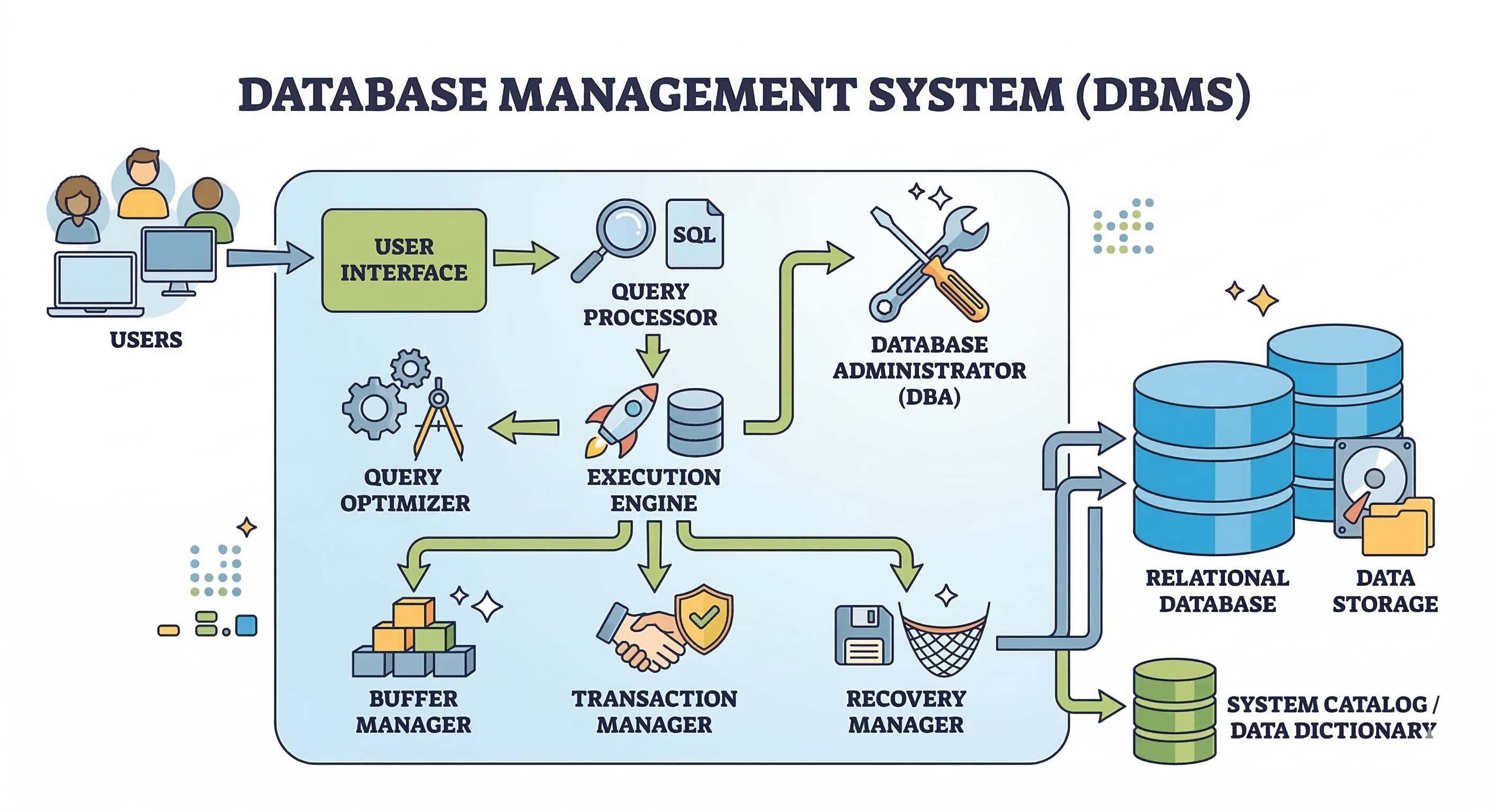
Core Functions of a DBMS:
- Data Definition: Allows you to define the structure (schema) of the database — creating tables, specifying data types, setting constraints, and establishing relationships.
- Data Manipulation: Provides mechanisms to insert, update, delete, and query data (typically through SQL).
- Data Storage Management: Handles how data is physically stored on disk, including indexing, buffering, and storage optimization for fast access.
- Transaction Management: Ensures that a series of operations either all succeed or all fail together (atomicity), keeping the database in a consistent state. This is governed by the ACID properties: Atomicity, Consistency, Isolation, and Durability.
- Concurrency Control: Manages simultaneous access by multiple users or applications, preventing conflicts and data corruption when several people modify data at the same time.
- Access Control & Security: Enforces authentication and authorization — controlling who can connect to the database and what operations they are permitted to perform.
- Backup & Recovery: Provides tools and mechanisms to back up data and restore the database to a consistent state after a failure.
- Data Integrity: Enforces rules (constraints) that keep data accurate and valid, such as ensuring a value is unique or that a reference to another table actually exists (referential integrity).
Well-known DBMS examples include MariaDB, PostgreSQL, MySQL, SQLite, Oracle Database, and Microsoft SQL Server.
DBMS GUI Tools — And How They Differ from the DBMS
A DBMS GUI (Graphical User Interface) tool is a separate desktop or web application that provides a visual, user-friendly interface for interacting with a DBMS. While the DBMS is the engine that actually stores and processes data, a GUI tool is simply a client that connects to the DBMS and sends commands on your behalf.
Examples of popular DBMS GUI tools:
| Tool | Works with |
|---|---|
| DBeaver | MariaDB, PostgreSQL, MySQL, SQLite, and many more |
| TablePlus | MariaDB, PostgreSQL, MySQL, SQLite, and more |
| pgAdmin | PostgreSQL |
| MySQL Workbench | MySQL / MariaDB |
| DataGrip | Most major DBMS |
| HeidiSQL | MariaDB, MySQL, PostgreSQL |
| DB Browser for SQLite | SQLite |
Key differences between a DBMS and a GUI tool:
| Aspect | DBMS | DBMS GUI Tool |
|---|---|---|
| Role | The database engine — stores, manages, and processes data | A client application — connects to the DBMS to display and edit data |
| Required? | Yes — cannot store or query data without it | No — optional convenience tool; the DBMS works without it |
| Runs where? | Typically on a server (or locally for SQLite) | On the developer's or administrator's machine |
| Interface | Command-line / programmatic API | Visual windows, query editors, table browsers |
| Capabilities | Full control over storage, transactions, security | Subset of DBMS features, presented visually |
In short, the DBMS is the engine and the GUI tool is the dashboard. You can drive without a dashboard, but the dashboard makes it far easier to see what is happening and control things. Throughout this course we will primarily interact with databases using SQL directly, which is the language understood by every DBMS — regardless of which GUI tool you may choose to use alongside it.
Relational Databases: Our Focus
For this course, we will be diving deep into Relational Databases and the SQL (Structured Query Language) used to interact with them. The relational model, with its well-defined structure and powerful querying capabilities, remains a cornerstone of data management and analysis.
In the next lesson, we'll delve into the fundamental concepts of relational databases, including tables, columns, rows, and the crucial role of keys.
Key Takeaways from this Lesson:
- A database is an organized and persistent collection of structured data.
- Databases are essential for storing, managing, retrieving, and sharing information.
- A DBMS is the software engine that stores, manages, and controls access to a database — providing data definition, manipulation, transaction management, security, and more.
- A DBMS GUI tool is an optional client application that provides a visual interface to a DBMS — it is separate from the DBMS itself.
- We will primarily focus on Relational Databases (RDB) and SQL in this course.
Welcome aboard! Let's continue our journey into the world of SQL.